
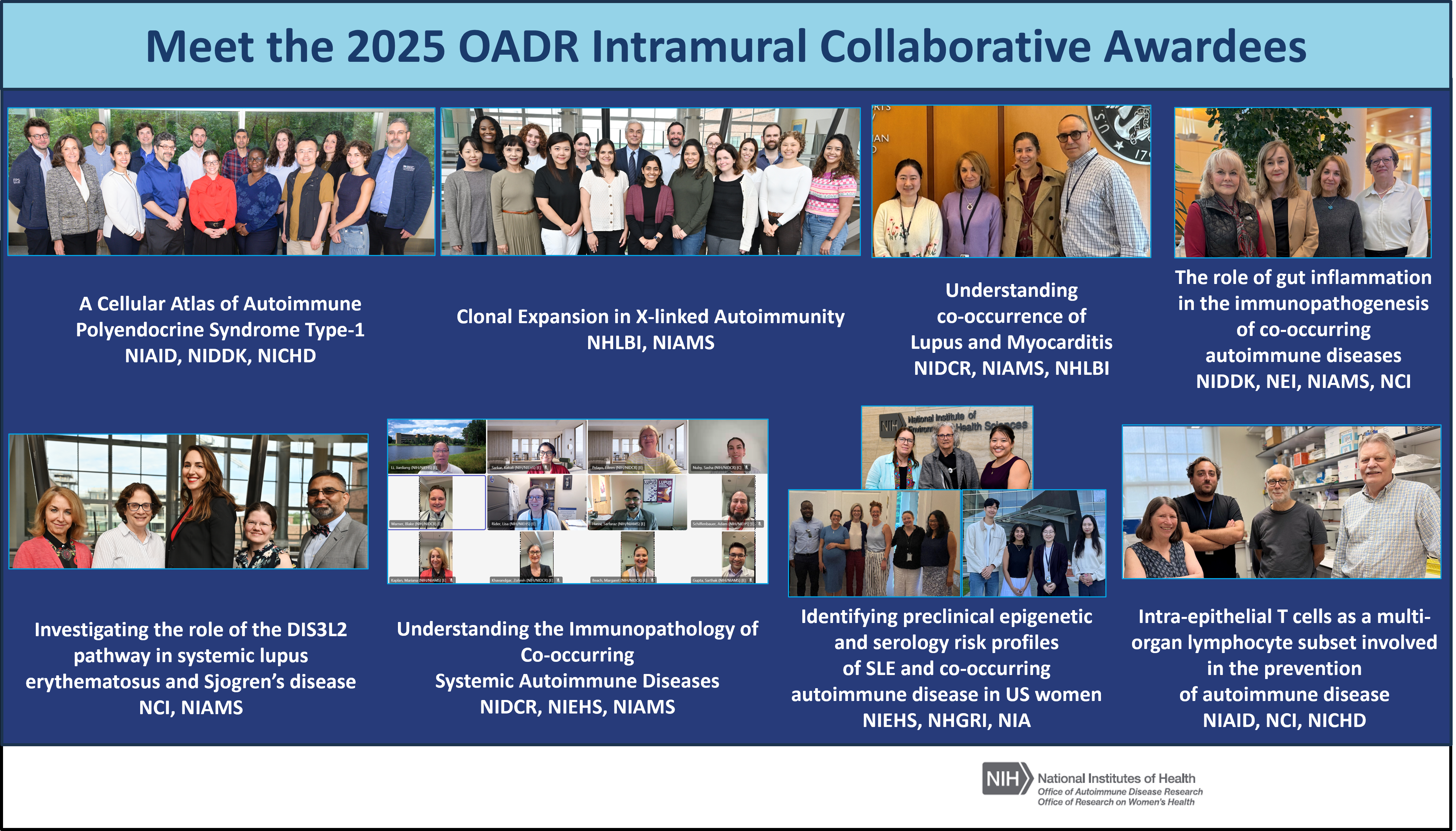
The Office of Autoimmune Disease Research in the Office of Research on Women’s Health (OADR-ORWH) is pleased to introduce the recipients of the 2025 OADR Intramural Collaborative Research Awards on Co-occurring Autoimmune Diseases. These awards were designed to foster collaborative research across NIH Institutes and Centers (ICs) and promote studies on the co-occurrence of autoimmune diseases, a domain with very limited understanding. In FY25, eight collaborative awards were made encompassing 21 different principal investigators, 11 individual ICs, 12 portfolio areas and 19 different autoimmune diseases. Learn more about the awardees and their compelling work below.
Investigating the role of the DIS3L2 pathway in systemic lupus erythematosus and Sjogren's disease
NCI, NIAMS
Systemic lupus erythematosus (SLE) is an autoimmune connective tissue disease that causes significant morbidity and mortality and primarily affects women in their childbearing years. One in five patients with SLE experiences disease onset in childhood, and this early presentation is associated with higher SLE disease activity and increased risk of complications and death. The frequency of co-occurring autoimmune diseases in patients with SLE is high; studies have estimated that 30-40% of SLE patients have at least one other autoimmune disease, with Sjögren’s disease being the most common. Prior research has implicated abnormalities of RNA sensing in SLE, but the extent to which defects in RNA surveillance result in immune dysregulation in SLE and Sjögren’s disease is unknown. This project aims to understand the pathogenesis of SLE and Sjögren’s disease, which frequently co-occur, using genomics as a lens into shared mechanisms of disease across the lifespan. Combining genomics with transcriptomics will elucidate precise pathways of inflammation which may be shared or unique to each condition.
Investigative Team
This project is a collaboration between Laura Lewandowski, M.D., M.S., a pediatric rheumatologist with expertise in genomics in NIAMS who has discovered rare genetic variants in RNA surveillance proteins in her cohort of childhood SLE patients, and Sandra Wolin, M.D., Ph.D., an expert in RNA surveillance at NCI working with Dr. Sandra Williams to understand mechanisms by which RNA surveillance disruption leads to immune activation. Other collaborators on this project include Dr. Blake Warner, who leads the NIH’s Sjögren’s disease clinic at NIDCR, Dr. Mariana Kaplan, chief of the NIAMS Systemic Autoimmunity Branch, and Dr. Sarfaraz Hasni, head of the NIAMs Lupus Clinical Trials Unit. With the combined expertise of this scientific team, the investigators aim to advance understanding of mechanisms driving inflammation and identify more targeted and effective therapy for patients with autoimmune diseases.
Identifying preclinical epigenetic and serology risk profiles of SLE and co-occurring autoimmune disease in U.S. women
NIEHS, NHGRI, NIA
Systemic lupus erythematosus (SLE) is a debilitating systemic autoimmune disease that disproportionally affects women. Individuals with SLE are also at increased risk of developing a second autoimmune disease; however, the biologic mechanisms that contribute to the risk of developing co-occurring autoimmune diseases have been understudied. The Sister Study is a longitudinal study initiated by NIEHS that recruits sisters of women diagnosed with breast cancer to investigate the genetic and environmental risk factors for breast cancer and other conditions including autoimmune diseases. This research will investigate 400 Sister Study participants who had no autoimmune disease at baseline and compare those who remained autoimmune disease free at follow up, those who developed SLE alone, and those who developed SLE along with another co-occurring autoimmune disease. The researchers will carry out an epigenome wide association study (EWAS) to determine whether patterns of DNA methylation and methylation-based markers of epigenetic aging, immune cell proportions, and protein profiles differ in relation to SLE diagnosis and co-occurring autoimmune diseases. They also will study diagnostic autoantibodies and viral antibodies using a novel immunoproteomics panel. This work will facilitate future research in the Sister Study linking life course social and environmental exposures to epigenetic and immunoproteomic factors in women with autoimmune diseases.
Investigative Team
An interdisciplinary team of researchers at NIEHS, NHGRI/NIAMS, and NIA is focused on identifying preclinical epigenetic and serological risk profiles of co-occurring autoimmune diseases. This work represents a multi-IC collaboration with expertise in epidemiology, molecular genomics, immunoproteomics, autoimmunity, and rheumatology. Dale Sandler, Ph.D. (Lead PI) is Chief of the NIEHS Epidemiology Branch and Senior PI of the Sister Study, a large prospective cohort of U.S. women that will serve as the basis of the planned project. Dr. Sandler is a chronic disease epidemiologist with over 40 years of experience studying the impact of environmental exposures on population health. Lindsey Criswell, M.D., M.P.H., D.Sc. (Co-PI) is the Head of the Genomics of Autoimmune Rheumatic Disease Section at NHGRI. As a rheumatologist and physician-scientist, her research focuses on the identification of genetic and epigenetic risk factors for autoimmune disease. Minkyo Song, M.D., Ph.D. (Co-PI) is a Principal Investigator at NIA in the Immunoepidemiology Unit with expertise in immunoproteomics and identifying biomarkers of autoimmune disease. The work will be supported by Dr. Christine Parks, a NIEHS staff scientist in the Epidemiology Branch who studies environmental exposures and autoimmune diseases. The research team is rounded out by four postdoctoral fellows: Dr. Jennifer Woo (NIEHS), a social and life course epidemiologist and OADR Fellowship recipient (2023 and 2024); Dr. Mary Horton (NHGRI), a genetic epidemiologist and computational biologist; Dr. Meghan Nelson (NHGRI), a translational scholar and pediatric rheumatologist; and Dr. Choa Yun (NIA), a biostatistician with expertise in longitudinal modeling and immunoproteomics.
A Cellular Atlas of Autoimmune Polyendocrine Syndrome Type-1
NIAID, NIDDK, NICHD
Autoimmune polyendocrine syndrome type-1 (APS-1), also known as Autoimmune polyendocrinopathy-candidiasis-ectodermal dystrophy (APECED), is a monogenic autoimmune disease caused by loss-of-function variants in the autoimmune regulator (AIRE) gene. AIRE deficiency impairs thymic tolerance causing escape of self-reactive T cells from central deletion, autoantibody generation, multiorgan inflammation and tissue dysfunction. APS-1 patients experience severe morbidity, infertility from gonadal failure, and high mortality.
Dysregulated interferon-gamma (IFN-g) responses are a core feature of APS-1, and Janus kinase (JAK) inhibition with ruxolitinib induces remission of 20 autoimmune manifestations including alopecia, Sjogren’s syndrome, candidiasis, gastritis, and enteritis in APS-1 patients. The precise immune mechanisms underlying tissue-specific pathology in APS-1 and the molecular pathways by which JAK-inhibition specific disease manifestations are unknown. Autoimmune oophoritis is a particularly devastating manifestation of APS-1 and affects ~70% of female patients with this disease. The optimal therapeutic approach to preserve fertility for women with APS-1 is unknown, and understanding mechanisms of autoimmune oophoritis in APS-1 will likely yield important insights for understanding autoimmune oophoritis in the broader population.
In this newly funded project, a collaborative team from NIAID, NIDDK, and NICHD will undertake an integrated temporal and spatial single-cell analysis of blood and four target tissues (skin, duodenum, salivary glands, and ovaries) from ruxolitinib-naïve APS-1 patients to map immune landscapes and define mechanisms of tissue-specific immune dysregulation.
Investigative Team
Since 2013, the lab of Michail S. Lionakis, M.D., Sc.D.at NIAID has established and evaluated the world’s largest APS-1 cohort (>200 patients) in collaboration with a multidisciplinary clinician-scientist team spanning 10 NIH institutes. Dr. Lionakis’ team will lead patient recruitment, tissue collection, and initial profiling in collaboration with Behdad (Ben) Afzali, M.D., Ph.D.’s group at NIDDK, which specializes in transcriptomic analyses of immune regulation in health and disease. In parallel, ovarian tissue cryopreservation will be offered for fertility preservation, with a portion designated for research biobanking, in partnership with Veronica Gomez-Lobo, M.D.’s team at NICHD, leaders in pediatric and adolescent gynecology. By studying this prototypic disorder of defective central tolerance, this multidisciplinary team aims to uncover new disease mechanisms, identify biomarkers, develop targeted therapies, and advance understanding of other autoimmune conditions.
Understanding co-occurrence of Lupus and Myocarditis
NIDCR, NIAMS, NHLBI
This project seeks to uncover the cellular and molecular mechanisms underlying myocarditis a rare but life-threatening inflammation of the heart which can co-occur with systemic lupus erythematosus (SLE). In addition, the team will investigate the possibility of subclinical Lupus Myocarditis (LM) in patients characterized by peripheral expansion of inflammatory dendritic cells.
Integrating patient-based observational studies with mechanistic research in autoimmune mouse models, this project will bridge basic and clinical research. This collaboration brings together deep expertise in immunology, rheumatology, and cardiology to dissect cardiac complications in patients with autoimmune disease via a translational, systems-level approach. The team will combine genetically engineered mouse models, in vivo cardiac imaging, tissue biomarker analysis, and high-dimensional immune profiling to delineate immune cell subsets—particularly dendritic cells and inflammatory myeloid cells—that may drive myocardial injury in lupus. They hypothesize that pro-inflammatory conventional dendritic cells (cDCs) may accelerate tissue-specific autoimmunity, while anti-inflammatory cDCs may exert regulatory effects by counteracting inflammation and maintaining immune balance within cardiac tissue. The ultimate goal is to identify therapeutic targets and establish both clinical and mechanistic frameworks for risk stratification and improved management of SLE patients with cardiac involvement.
Investigative Team
This collaborative team brings together investigators from three NIH Institutes with complementary expertise. Roxane Tussiwand, Ph.D. (NIDCR) and her postdoctoral fellow Dr. Haiting Wang, initiated this interinstitutional effort, partnering with Mariana Kaplan, M.D. at NIAMS, and Michael Sack, M.D., Ph.D. at NHLBI. Dr. Tussiwand is a tenure-track investigator with expertise in hematopoietic cell commitment, transcriptional regulation, and dendritic cell biology. Dr. Mariana Kaplan, NIH Distinguished Investigator and Chief of the Systemic Autoimmunity Branch at NIAMS, is a leading physician-scientist whose work has significantly advanced the understanding of innate immune mechanisms in lupus, vasculopathy, and systemic autoimmunity. Dr. Michael Sack, senior investigator and Chief of the Cardiovascular Branch at NHLBI, is a recognized leader in mitochondrial biology, immunometabolism, and intracellular quality control, with a focus on cardiometabolic regulation in inflammatory diseases.
Intra-epithelial T cells as a multi-organ lymphocyte subset involved in the prevention of auto-immune disease
NIAID, NCI, NICHD
Autoimmune diseases are a major cause of morbidity and mortality, especially in women and in patients undergoing immune checkpoint blockade therapy for cancer. T lymphocytes serve dual functions in the regulation of immunity. In autoimmunity, effector T cells produce inflammatory cytokines and cause tissue destruction directed at self-antigens. However, immunoregulatory T cells inhibit tissue damage by acting on effector T cells or other tissue components.
The goal of this collaborative project is to investigate the potential role of a newly appreciated subset of immunoregulatory T cells known as Intraepithelial Lymphocytes in prevention of autoimmunity. While Foxp3-expressing regulatory T (Treg) cell are the best characterized self-reactive immunoregulatory T cells, the intestinal epithelium hosts a distinct subset of Foxp3-negative immunoregulatory T cells, termed Intraepithelial Lymphocytes (IELs), which can suppress inflammatory responses in mouse models of inflammatory bowel disease. The investigative team has recently found similar cell subsets in other epithelial tissues and organs and have shown roles for these IELs in tissue remodeling during pregnancy and lactation. These data suggest an important, yet unappreciated, role of IELs in the control of autoimmunity, inflammation and tissue remodeling, including responses to infection. The team hypothesizes that IELs may help limit immunopathology and are critical for the prevention of autoimmunity. They propose to characterize such intraepithelial T cell populations, including their pathways of development in the thymus, and their functions in suppressing inflammation and auto-immunity, so as to better understand how IELs may be affected by inflammation, autoimmunity and infection.
Investigative Team
The labs of Pamela L. Schwartzberg, M.D., Ph.D.(NIAID), Remy Bosselut, M.D., Ph.D.(NCI) and Paul E. Love, M.D.,Ph.D.(NICHD) share a common interest in T cell biology, including studies of T lymphocyte development and function. Through strong, complementary backgrounds in thymic development (Bosselut, Love, Schwartzberg), gene regulation (Bosselut), T cell functional responses to infection and cancer (Bosselut, Love, Schwartzberg) and T cell signaling (Love and Schwartzberg), these collaborative scientists hope to harness novel mouse models to understand drivers of autoimmunity that may have long-lasting impact on human health.
The role of gut inflammation in the immunopathogenesis of co-occurring autoimmune diseases
NIDDK, NEI, NIAMS, NCI
The goal of this collaboration is to explore how gastrointestinal inflammation and gut microbiota modulate sex differences in the co-occurring autoimmune diseases systemic lupus erythematosus (SLE), multiple sclerosis (MS), and uveitis. While previous studies have examined sex differences in individual autoimmune diseases, little is known about how inflammatory processes in one organ system, such as the gut, influence the systemic immune landscape in a sex-dependent manner. Through this work, the scientific team hopes to better delineate the impact of gut-driven inflammation on immune cell activation, signaling pathways, and clinical autoimmunity in males and females. Furthermore, the team hopes to better define the role of gut microbiota in mediating gut-to-systemic immune interactions across different autoimmune diseases.
Investigative Team
This collaboration brings together the expertise of four investigators from four NIH institutes to study the immunopathogenesis of potentially co-occurring autoimmune conditions: SLE (Mariana Kaplan, M.D., NIAMS), MS (Vanja Lazarevic, Ph.D., NCI), uveitis (EAU; Rachel Caspi, Ph.D., NEI) and inflammatory bowel disease using mouse models with natural microbiota (IBD; Barbara Rehermann, M.D., NIDDK).
Clonal Expansion in X-linked Autoimmunity
NHLBI, NIAMS
Paroxysmal nocturnal hemoglobinuria (PNH) and VEXAS (vacuoles, E1 enzyme, X-linked, autoinflammatory, somatic mutation) syndrome are two prominent examples of clonal diseases which originate in a somatic mutation in genes located on the X chromosome.
In these disorders, genetic changes in hematopoietic stem cells which occur commonly throughout life, undergo clonal expansion and form a population of pathogenic cells inducing pathology in multiple organ systems. The clinical manifestations of these diseases correlate with the extent of the mutated clonal expansion. In PNH the mutation is known as PIGA and in VEXAS the mutation is UBA1. PNH typically manifests with intravascular hemolytic anemia due to complement-mediated lysis; venous thromboses; and low blood counts secondary to failure of the bone marrow to produce sufficient red cells, white cells, and platelets. VEXAS presents with recurrent fevers, arthritis, skin lesions, lung inflammation, blood clots and progressive bone marrow failure through myelodysplasia. This project will focus on drivers of clonal expansion in these somatic mutation disorders, and the resulting autoimmune manifestations of these disorders.
Investigative Team
The labs of Neal Young, M.D. (NHLBI) and Peter Grayson, M.D., M.Sc.(NIAMS) bring together staff scientists and fellows with expertise in single cell technologies including Fernanda Gutierrez Rodrigues (NHLBI), Zhijie Wu (NHLBI), Shouguo Gao (NHLBI), Luciana Yamamoto de Almeida (NIAMS), Urvashi Kaundal (NIAMS) as well as clinical staff with expertise in the disease including Bhavisha Patel (NHLBI), Emma Groarke (NHLBI), Kaitlin Quinn (NIAMS), Alice Fike (NIAMS), Benjamin Turturice (NIAMS), and Julie Onyechi (NIAMS). This proposal builds on single cell RNA sequencing work in PNH where the team discovered that small PNH clones exhibit markedly different immune signatures compared to large clones providing direct evidence of “clonal escape”. The timing and mechanism of emergence, selection, and expansion of clones in both diseases is unclear, and this project will address the possibilities of new mutations, functional protein defects and epigenetic modifications affecting cell behavior in these complex diseases.
Understanding the Immunopathology of Co-occurring Systemic Autoimmune Diseases (SAiD)
NIDCR, NIEHS, NIAMS
This project aims to investigate mechanisms driving complex autoimmune presentations by focusing on patients who simultaneously meet criteria for two or more systemic autoimmune diseases (SAiDs). Co-occurring autoimmune diseases provide a powerful yet underexplored opportunity to dissect shared and unique organ-specific immunopathology. The scientists will collaborate across several ongoing clinical studies at NIH to integrate clinical phenotyping with bulk RNA sequencing, spectral flow cytometry, and cutting-edge spatial biology approaches to define how systemic immune dysregulation manifests in different tissues. By linking molecular and clinical endotypes to specific immune infiltrates across organs, they aim to create a new framework for investigating co-occurring SAiD based on immunophenotypes. This work has the potential to identify novel precise, tissue-specific therapeutic strategies that shift paradigms in autoimmune disease diagnosis and treatment.
Investigative Team
This project brings together a unique multidisciplinary team from three NIH ICs with complementary strengths. Blake Warner, D.D.S., Ph.D., M.P.H. (NIDCR, PI) contributes expertise in epithelial biology and salivary gland immunopathology; Lisa Rider, M.D. (NIEHS, Co-I) leads studies on systemic inflammatory myopathies and drives transcriptional analyses; and Mariana Kaplan, M.D. (NIAMS, Co-I) offers deep experience in lupus and rheumatoid arthritis (RA) pathogenesis and advanced flow cytometry. The clinical team includes expert staff clinicians across NIDCR, NIAMS, and NIEHS who have curated well-phenotyped SAiD cohorts with matched biospecimens and biopsies from multiple organs. This collaboration capitalizes on existing NIH resources, patient cohorts, and biospecimen repositories in a novel and synergistic way. By uniting multi-modal profiling across different tissues under a common analytical framework, this project has the potential to transform our understanding of overlapping autoimmune diseases and unlock new therapeutic avenues that transcend traditional disease boundaries.